Dec
17
RUN FOR GREEN (TREES)
Dec
17
NDA
NDA- National Defence Academy

UPSC has released the New advertisement for National Defense Academy and Naval Academy Examination (I), 2022. All the candidates who want to appear in this recruitment can apply online from 22 December 2021 to 11 January 2022. NDA 2022 recruitment exam will be held on tentatively 10 April 2022. Other information related to this recruitment like selection procedure, age , pay scale, syllabus information is available in this advertisement.
NDA-2022/ SYLLABUS & SCHEME
Mathematics Paper Code 01 2½ Hours 300 Marks
General Ability Test Paper Code 02 2½ Hours 600 Marks
UPSSSC Preliminary Examination Test (PET) 2021
Important Dates
Application Begin : 25/05/2021
Last Date for Registration : 21/06/2021
Last Date for Fee Payment : 21/06/2021
Correction Last Date : 28/06/2021
Exam Date : Notified Soon
Application Fee
General / OBC : 185/-
SC / ST : 95/-
PH (Dviyang) : 25/-
Age Limit as on 01/07/2021
Minimum Age : 18 Years
Maximum Age : 40 Years
Age Relaxation Extra as per Rules
Eligibility
Minimum Class 10 High School Exam in Any Recognized Board OR Any Higher Qualification in Any Recognized University in India.
UPRPB- Uttar Pradesh Police Recruitment and Promotion Board Examination 2021
UP Police ASI Confidential / Clerk / Accountant Recruitment 2021
Vacancy Details Total : 1329 Post
Important Dates
Application Begin : 01/06/2021
Last Date for Apply Online : 15/07/2021
Last Date Pay Exam Fee : 15/07/2021
Exam Date : Notified Soon
Admit Card Available : Notified Soon
Application Fee
General / OBC : 400/-
SC / ST : 400/-
All Category Female : 400/-
Pay the Examination Fee Through Cast at E Challan or Debit Card, Credit Card, Net Banking
Age Limit as on 01/07/2021
Minimum Age : 21 Years.
Maximum Age : 28 Years.
Age Between : 01/07/1993 to 01/07/2000
Age Relaxation Extra as per Rules.
Dec
17
Regular Study
7 Days Regular Classes and Daily Testing.
Full ONLINE/OFFLINE Support to the students
Dec
17
Physics IX
ICSE Physics IX Syllabus
- Measurement And Experimentation
- Motion in One Dimension
- Newton’s Laws of Motion
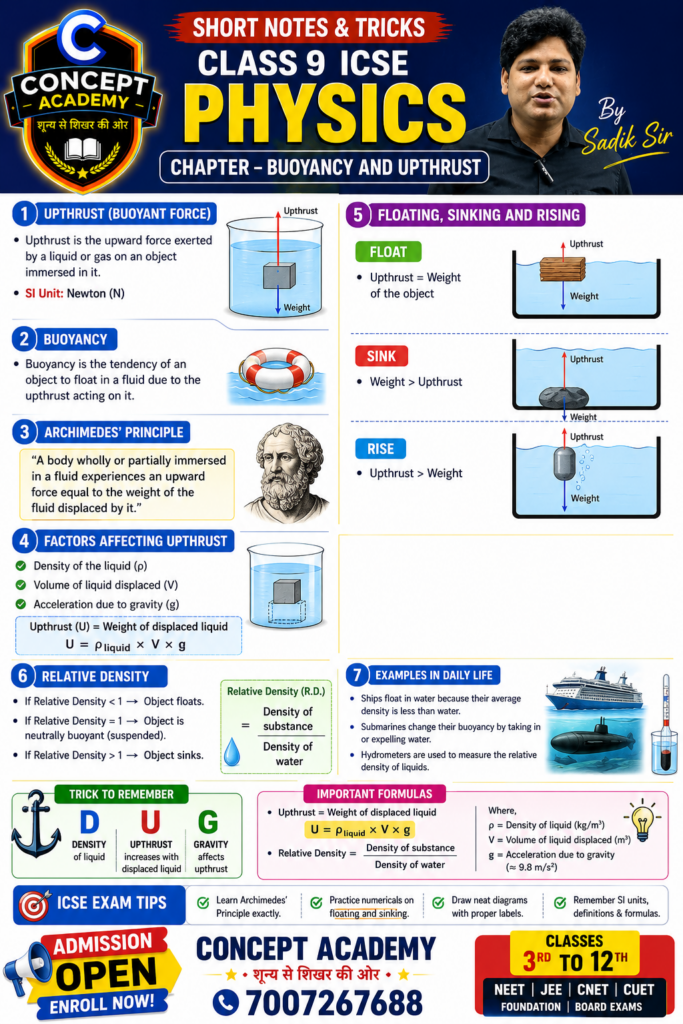
- Fluids
- Electricity
- Magnetism
Aims:
- To acquire knowledge and understanding of the terms, facts, concepts, definitions, laws, principles and processes of
- To develop skills in practical aspects of handling apparatus, recording observations and in drawing diagrams, graphs, etc.
- To develop instrumental, communication, deductive and problem-solving skills.
- To discover that there is a living and growing physics relevant to the modern age in which we live
There will be one paper of two hours duration carrying 80 marks and Internal Assessment of practical work carrying 20 marks.
The paper will be divided into two sections, Section I (40 marks) and Section II (40 marks).
Section I (compulsory) will contain short answer questions on the entire syllabus.
Section II will contain six questions. Candidates will be required to answer any four of these six questions.
Note: Unless otherwise specified, only SI Units are to be used while teaching and learning, as well as for answering questions.
- Measurements and Experimentation
- Motion in One Dimension
- Laws of Motion
- Fluids
- Heat and Energy
- Light
- Sound
- Electricity and Magnetism
Dec
17
Biology Part-I
Chapter 2 : Biological Classification
Chapter 3 : Plant Kingdom
Chapter 4 : Animal Kingdom
Chapter 6 : Anatomy of Flowering Plants
Chapter 7 : Structural Organisation in Animals
Chapter 8 : Cell : The Unit of Life
Chapter 9 : Biomolecules
Chapter 10 : Cell Cycle and Cell Division
Dec
16
Chemistry XII
NCERT Chapter Chemistry XII
Chapter 9 Coordination Compounds
Chapter 10 Haloalkanes and Haloarenes
Chapter 11 Alcohols Phenols and Ethers
Chapter 12 Aldehydes Ketones and Carboxylic Acids
Chapter 13 Amines
Chapter 14 Biomolecules
Chapter 15 Polymers
Chapter 16 Chemistry in Everyday Life
Dec
05
CONCEPT NEET APP
CRACK
NEET & IIT-JEE
IN SINGLE ATTEMPT
This app equally important for NEET and IIT-JEE Exams as well as academics of Standard 11th & 12th
Students are advised to Download this app for Standard 11th and standard 12th studying and 12th passed out students who wants to crack NEET & IIT-JEE Exam in single attempt.
Click the link below and download the app
https://play.google.com/store/apps/details?id=study.pedagogy.conceptacademy
Stept for free pack of Rupees 9999/-
Click the above link
Download CONCEPT NEET app from Play store
Apply the access code given below
Access codes for your students –
JEE 11 JEE12 NEET11 NEET12
| ET7MN89A | TNLXQVKT | H2I4H4GE | CPIXD58A |