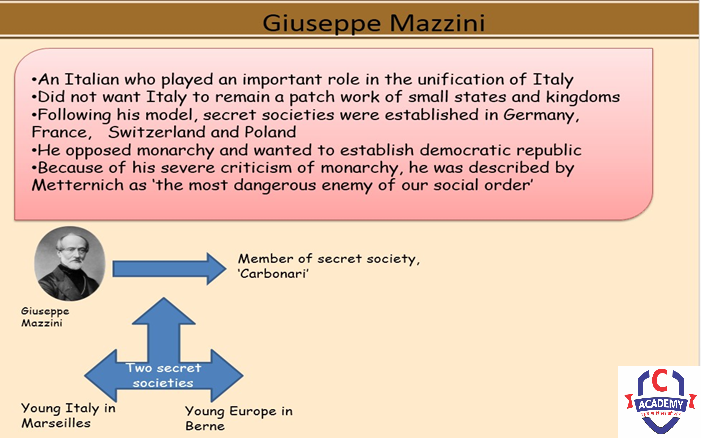
Frederic Sorrieu was a French artist who in 1848 prepared a series of four prints visualising his dream of a world made up of ‘Democratic and Social Republics’.
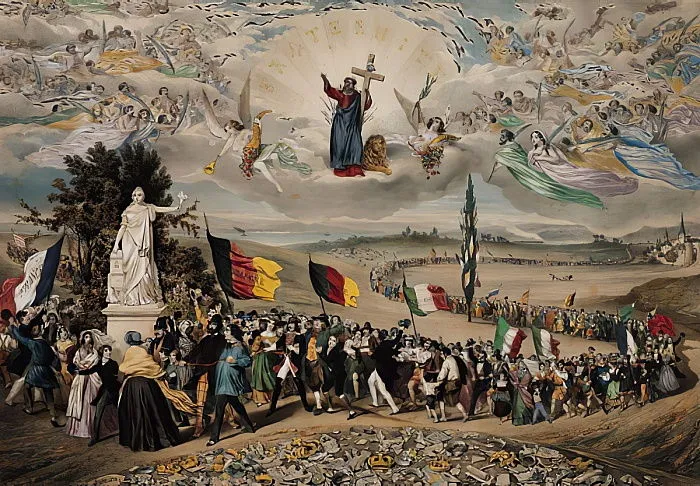
The Dream of Worldwide Democratic and Social Republics – The Pact Between Nations, a print prepared by Frédéric Sorrieu, 1848.
The features of Frédéric Sorrieu’s paintings were:
- The people of Europe and America marching in a long line are paying homage to the Statue of Liberty. This shows that they wanted and appreciated the principles of liberty, equality and fraternity.
- On the foreground of the image lie the shattered symbols of monarchical regimes signifying downfall of the monarchical and absolutists regimes.
- In this image, people are grouped as distinct nations identified by their flags and national costumes. This depict the rise of nation states in Europe and America.
A Nation State refers to a country with well-defined delineated boundaries, resided by people with a similar culture and character. It is also supposed to have a government of its choice. The people in a Nation State are supposed to have unity, strength and cooperation.
The French Revolution and the Idea of the Nation
The French Revolution is regarded as one of the most important events in history. It not only gave a huge setback to monarchy but also gave the first clear expression to the idea of ‘nationalism’. The French Revolution led to the transfer of sovereignty from monarchy to the French citizens. The Constitution in France came into existence and citizens were awarded with the rights of liberty and equality.
The French revolutionaries introduced various measures and practices to create a sense of collective identity amongst the French people. These were:
- The ideas of la patrie (the fatherland) and le citoyen (the citizen) was introduced.
- The Estates General was renamed the ‘National Assembly’. Its members were elected by active citizens (citizens who paid taxes to the government).
- The new French flag replaced the former royal standard.
- Nation now became supreme. Hymns were composed and oaths were taken on the name of the nation. It was regarded as a ‘fatherland’.
- The administrative system was centralised, and uniform laws were formulated for all citizens.
- A uniform system of weights and measures was adopted, and internal custom duties and dues were abolished.
- The French language was made the common language of the people residing in France.
- The revolutionaries declared that their next motive is to help other people of Europe to become nations.
- The French Revolution impacted the middle class including professionals and students in several countries such as Switzerland, Holland, Italy and Belgium. They also wanted to throw off the monarchies in their countries and become nations.
Napoleon – Child of the French Revolution
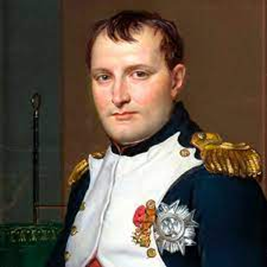
Napoleon Bonaparte is known as the ‘Child of the French Revolution’
The rise of Napoleon marked the rise of monarchy in France. However, Napoleon implemented some revolutionary ideas and principles in France. He did this by taking the following steps:
He introduced the Civil Code of 1804, also known as the Napoleonic Code. This Code instituted the principle of equality of all people before the law, right to property was established and all privileges enjoyed by the people of high birth and class were abolished.
- This Code was also promulgated to other parts of Europe which were controlled by France.
- In many European countries such as Switzerland, Germany, Dutch Republic and Italy, he simplified the administrative machinery, ended
the feudal system and liberated the peasants from serfdom.
- In towns, restrictions imposed on guilds were removed, and transport and communication systems were improved. Businessmen, small
Napoleon Bonaparte is known as the ‘Child of the French Revolution’.
industrialists and traders began to realise the importance and advantages of a uniform system of laws.
- People of other European countries initially welcomed the French armies but later began to oppose them because of increased taxation and censorship imposed on them.
The Beginning of Nationalism in Europe
During the mid-eighteenth century, there were no nation states in Europe. Italy, Germany and Switzerland were not one nation but were divided into various kingdoms. Central and eastern Europe was under absolute monarchies. Several factors led to the emergence of the idea of nationalism in the later half the eighteenth century. Some of these were the rise of the middle class, liberalism and the rise of a new conservatism after 1815 and its opposition by the people.
Rise of the new middle class: The aristocratic class in Europe was a dominant class, but it was comprised of only few people. Most of the people in Europe were peasants. The Industrial Revolution resulted in the emergence of the labour or working class. Many small industrialists, businessmen and professionals who formed the middle class gained prominence. These classes supported the abolition of aristocratic privileges, demanded equality and advocated the idea of nationalism.
Liberalism: The middle class stood for ‘liberalism’. Liberalism in political terms stood for equality, freedom, formation and working of government by consent. In the economic field, liberalism advocated the freedom of markets and the abolition of unjust duties on the movement of goods from one territory to the other. This led to the beginning of economic nationalism in Europe which contributed to the rise of nationalism. The new commercial class argued for the creation of a unified economic territory allowing the unhindered movement of goods, people and capital. Later, several measures were introduced. Some of these were
- In 1834, a customs union called ‘zollverein’ was formed at the initiative of Prussia. Several German states joined this union
- The union abolished tariff barriers and reduced the number of currencies from over thirty to two.
- The introduction of railways created mobility leading to the national unification.
- The creation of a network of railways further stimulated mobility harnessing economic interests to national unification.
We find that a wave of economic nationalism strengthened the wider nationalist sentiments growing at the time.
Rise of New Conservatism and its opposition by the people
After the defeat of Napoleon, there was a rise of new conservatism.
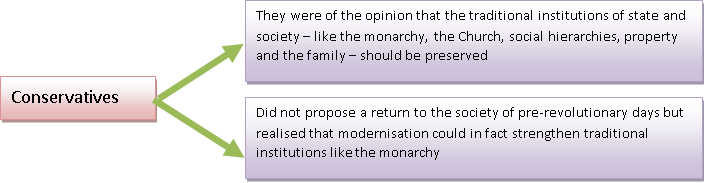
The Congress of Vienna was held in 1815 in which Britain, Russia, Prussia and Austria participated to draw up settlement for Europe. The Congress was hosted by the Austrian Chancellor Duke Metternich. Some results of the Congress of Vienna were:
- Monarchy was restored in France and strengthened in Prussia, Belgium and Austria. Autocratic governments were set up in these countries.
- A series of states were set up on the boundaries of France to prevent French expansion in future.
Conservative regimes set up in 1815 were autocratic. They did not tolerate dissent and imposed censorship on those materials and articles in newspapers, books, plays and songs that reflected the ideas of liberty and freedom.
These conservative ideas gave rise to liberal nationalists and revolutionaries. Liberals were opposed to monarchial governments. They advocated liberty and freedom and the creation of nation states. After 1815, many liberal nationalist went underground and established several secret societies.